Welcome
individual online training available with flxible timing
UK,IRE, NEWZELAND AND AUSTRALIA

UK,IRE, NEWZELAND AND AUSTRALIA

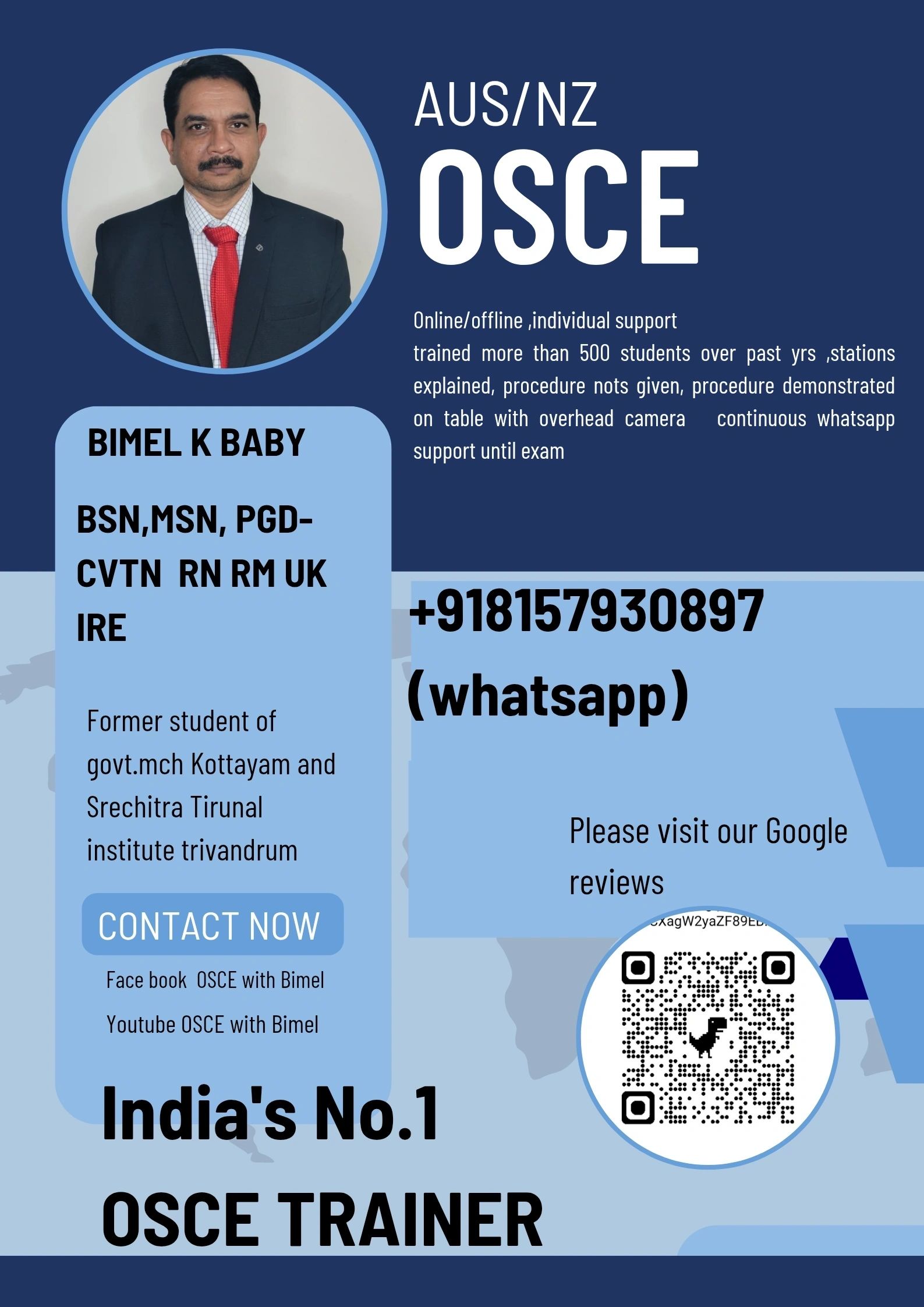
MSN, PGD-CVTN | OSCE Trainer nurse Educater ,former nurse and nurse manager UK ireland
Website Description (Professional Summary)
Bimel K. Baby
MSN, PGD-CVTN (SCTIMST) | OSCE Trainer & Nurse Educator | Former Nurse & Nurse Manager – UK & Ireland
With over 18 years of elite international healthcare expe
MSN, PGD-CVTN | OSCE Trainer nurse Educater ,former nurse and nurse manager UK ireland
Website Description (Professional Summary)
Bimel K. Baby
MSN, PGD-CVTN (SCTIMST) | OSCE Trainer & Nurse Educator | Former Nurse & Nurse Manager – UK & Ireland
With over 18 years of elite international healthcare experience, Bimel K. Baby is India’s most trusted OSCE trainer. He has guided hundreds of nurses to international success, achieving a 100% OSCE pass rate for every single candidate since 2021.
Why Bimel is India’s #1 OSCE Trainer
✅ 100% Success Record – Every nurse trained by Bimel has passed their OSCE since 2021.
✅ All-in-One Global Expert – The only trainer who prepares you for the UK, Australia, New Zealand, and Ireland – all under one roof.
✅ 18+ Years in UK & Irish Healthcare – Hands-on experience as a Staff Nurse and Clinical Nurse Manager in top-tier hospitals and long-term care facilities.
Clinical & Leadership Background (18+ Years)
· Clinical Nurse Manager – Manor Nursing Home, Co. Tipperary, Ireland (10 years)
· Clinical Nurse Manager (Hematology/Oncology & BMT) – OLHSC Crumlin, Dublin (6 years)
· Staff Nurse – Regional Cancer Centre (RCC) & Govt. Medical College, Trivandrum
· Nursing Lecturer – RVS College of Nursing & TCN Kangazha, Kottayam
Key Leadership Roles:
Lead of International Recruitment Board | COVID Control Team Leader | Infection Control Lead | Disciplinary Committee Chair | Preceptor & Mentor for BSc Nursing students and new hires.
Elite Education
· M.Sc. in Medical-Surgical Nursing (CVTN) – SCTIMST, Trivandrum (Institute of National Importance)
· PG Diploma (Cardiovascular & Thoracic Nursing) – SCTIMST, Trivandrum
· B.Sc. in Nursing – Govt. College of Nursing, Kottayam
Specializations & Certifications
· Bone Marrow Transplant (BMT) & Chemotherapy
· IV Therapy
· Preceptorship & Clinical Mentorship
Why Train with Bimel?
Bimel leverages deep insider knowledge of the UK and Irish healthcare systems to deliver a unique, highly effective system for OSCE and UK CBT training. He has successfully helped hundreds of nurses transition smoothly into their international careers – and he’s ready to help you, too.
Who We Are
OSCE with Bimel is a premier training institute offering offline & online OSCE preparation for nurses aiming to clear their OSCE exams in the UK, Ireland (IRE), Australia (AUS), and New Zealand (NZ).
With Bimel K. Baby – an experienced MSN, PGD-CVTN holder and dedicated OSCE trainer – at the helm, we provide latest exam scenari
Who We Are
OSCE with Bimel is a premier training institute offering offline & online OSCE preparation for nurses aiming to clear their OSCE exams in the UK, Ireland (IRE), Australia (AUS), and New Zealand (NZ).
With Bimel K. Baby – an experienced MSN, PGD-CVTN holder and dedicated OSCE trainer – at the helm, we provide latest exam scenarios, individualised attention, and unwavering support until you pass.
Our Track Record
🎓 2,000+ students successfully passed various OSCE exams
🌍 Trained candidates for UK, Ireland, Australia, New Zealand
⭐ Rated for high pass rates and realistic mock exams
What We Offer
Service
Details
Training Mode
Offline (limited seats) + Online (live interactive)
Target Exams
UK OSCE (CBT + OSCE), Ireland NMBI OSCE, Australia OSCE (AHPRA), NZ NCAP OSCE
Scenarios
Latest, exam-relevant, updated regularly
Mock Exams
Full-length, timed, with detailed feedback
Individual Attention
One-to-one mentoring & doubt clearing
24/7 WhatsApp Support
From enrollment until your exam day – ask anything anytime
Flexible Timing
Online batches available for working nurses – morning, evening, weekend slots
24/7 WhatsApp Support – Until Your Exam
We don’t leave you after class.
Get round‑the‑clock assistance via WhatsApp – for scenario doubts, procedure clarifications, or last-minute stress management.
📅 Online Flexible Timing
· Learn at your own pace
· timings that suit your schedule
Australia’s Nursing OSCE Is Nothing More Than a Carbon Copy of the UK and Europe
A recent video has sparked a necessary, albeit controversial, conversation: the claim that only Australian Registered Nurses (RNs) can teach the Objective Structured Clinical Examination (OSCE) because “the Australian OSCE is different.” This belief has be
Australia’s Nursing OSCE Is Nothing More Than a Carbon Copy of the UK and Europe
A recent video has sparked a necessary, albeit controversial, conversation: the claim that only Australian Registered Nurses (RNs) can teach the Objective Structured Clinical Examination (OSCE) because “the Australian OSCE is different.” This belief has become almost gospel among international nurses, fueling a multi-million dollar industry of “AHPRA-aligned” test preparation courses. However, this narrative is dangerously misleading. The truth, supported by regulatory documents and the very structure of the assessments, is that Australia has not innovated in nursing assessment. It has merely imported, rebranded, and localized a system that was perfected decades ago in the UK and Europe.
To suggest the Australian OSCE is an entirely unique entity is to ignore the fundamental reality of modern nursing: it is an international system, and Australia’s place in it is largely that of a follower, not a leader.
Nursing Is, and Always Has Been, an International System
The movement of the Australian nursing profession is inextricably linked to the broader currents of the international community. Nurses operate within a global framework shaped by organizations like the International Council of Nurses (ICN), which fosters "shared nursing values" and promotes the adoption of common standards across borders. Australia’s own regulations, like those of the UK, Canada, and New Zealand, are assessed against a "global standard of competence" for entry into the profession, a benchmark set by international dialogue and shared best practices.
This internationalist spirit is not a new phenomenon. The very foundation of Australia’s nursing regulatory system was a direct transplant. When South Australia passed its Nurses’ Registration Act 1920, it was "closely based on the Nurses’ Registration Act 1919 of the General Nursing Council for England and Wales". Australia was not a pioneer of nursing regulation; it was a willing and faithful adopter of the British model.
The Australian OSCE: A Derivation of the UK’s NMC Test of Competence
The modern OSCE is no different. The core format—a series of timed stations where a candidate performs a clinical skill or interacts with a patient—is standardized across virtually all English-speaking healthcare systems. When we look at the Australian OSCE for Enrolled Nurses (EN), we see it is comprised of 10 stations, each involving a clinical scenario designed to test nursing practice standards. The candidate is given two minutes of reading time, followed by eight minutes to demonstrate a required skill. For Registered Nurses (RN), the framework is a similar set of stations that assess everything from clinical proficiency to communication and professionalism.
Now, compare this to the UK’s OSCE administered by the Nursing and Midwifery Council (NMC). The UK test is also a station-based assessment with a total assessment time of no more than 2 hours and 45 minutes. Crucially, "the candidate has to pass all 10 stations before they can be accepted onto the NMC register for nurses". The structure is identical: stations testing clinical skills, patient interaction, and emergency scenarios.
Even Australia’s regulatory bodies are aware of this dependence. The University of Northampton in the UK is home to the busiest Competence Test Centre (CTC), where 700 international nurses take the OSCE each month. Delegates from the Nursing and Midwifery Council (NMC) and the Nursing Council of New Zealand visited this centre specifically to discuss the similarities in registering internationally educated practitioners and to "share best practice ideas". Australia was not teaching them a new system; it was sending its regulators to learn from the UK’s established model.
The Chilling Chart: How Australia Adopts European Clinical Tools
This influence goes beyond mere structure and infiltrates the very fabric of clinical practice. The most powerful evidence that nursing is a "parcel" of an international system lies in the clinical tools Australian nurses are expected to use. For decades, Australian hospitals have utilized traffic light system observation charts. These color-coded charts (green, yellow, orange, red) were developed in the UK and are a cornerstone of the National Early Warning Score (NEWS). Australia did not invent them; it adopted them. Similarly, the pain scale charts (e.g., the Wong-Baker FACES Pain Rating Scale), a universal tool used in Australian assessments, originate from international, collaborative health research that includes European contributions.
When an examiner in an Australian OSCE station hands a nurse a traffic light chart and asks them to assess a deteriorating patient, the nurse is not engaging with a uniquely Australian system. They are engaging with an international, evidence-based protocol that was developed in the UK and Europe. This is the "chilling" reality: the very artifacts used to assess "Australian-specific" practice are borrowed from a global toolkit.
The Great Misconception: Who Can Really Teach the OSCE?
This brings us back to the video’s claim: that only Australian RNs can teach the OSCE. While it is true that only an RN registered with AHPRA can practice in Australia, the logic that this translates to being the only person who can teach a clinical exam is a non sequitur.
The OSCE tests clinical competency and communication—skills that are universal. A surgeon in London can teach a surgical technique to a doctor in Sydney because the human anatomy does not change at the border. The same applies to nursing. An experienced nurse from the UK’s National Health Service (NHS) or the Irish Health Service Executive (HSE) is already intimately familiar with the station-based structure of the OSCE. They are already trained in the ICN ethical guidelines that underpin Australian practice.
The argument that only AHPRA-registered nurses can teach the test is a gatekeeping tactic. In reality, what matters is that the trainer understands the specific NMBA assessment criteria, not that they hold a current Australian nursing license. Many of the most effective OSCE preparation courses in India and the Philippines, where the vast majority of Australia-bound nurses train, are taught by experienced international nurse educators who have never set foot in an Australian hospital, yet their students pass the exam at high rates. The test is not a sacred text; it is a competency checklist.
Conclusion: The Pathology of an Insecure System
Australia’s insistence on the unique, proprietary nature of its nursing assessment system is a symptom of professional insecurity. By focusing on the Australian-ness of the exam rather than its clinical content, regulators and commercial training centers create an artificial barrier designed to generate revenue and enforce compliance. The multi-stage Outcome-Based Assessment (OBA) pathway, which includes the NCLEX-RN (a US-Canadian invention) and the OSCE (a British-born format), is a bureaucratic labyrinth, not a clinical standard.
The Australian OSCE is not a unique cultural artifact. It is a derivation of the UK’s NMC Test of Competence. Its clinical tools are borrowed from Europe. Its ethical framework is dictated by a global council. When an international nurse passes the OSCE, they have not proven they can think "The Australian Way." They have proven they are a safe, competent, professional nurse—a status that transcends any single country’s borders. The only thing truly unique about the Australian nursing system is the high cost and psychological stress of its redundant gatekeeping.
Rebuttal Corner (For Proponents of "Australian Uniqueness")
· Claim: "The legal scope of practice in Australia is different, so only an AHPRA nurse can teach it."
o Rebuttal: The OSCE is a clinical simulation of basic nursing tasks (e.g., hand-washing, wound care, medication calculations). These skills are not legally defined by AHPRA; they are defined by the global nursing literature. Teaching how to perform a tracheostomy suction does not require a license from the Australian Health Practitioner Regulation Agency. It requires clinical competence, which exists in the UK and Europe.
· Claim: "The NMBA Registered Nurse Standards for Practice are unique to Australia."
o Rebuttal: A 2026 document analysis comparing nurse competencies internationally found that "the majority of nurse competencies are met by the countries included in the study, and language unity is achieved to a large extent". The NMBA’s standards are a rephrasing of the ICN’s global code of ethics and the UK’s NMC Code. The concepts of communication, professionalism, and safety are not Australian inventions.
With a non-refundable $4,000 AUD exam fee on the line, your choice of training ground is everything.pptx: 3]. Many students spend ₹1.5 to ₹2 Lakhs on heavily pressurized 2-week programs in Australia, only to find massive groups, zero individual attention, and confusing stations managed by a rotating carousel of different trainers. Eve
With a non-refundable $4,000 AUD exam fee on the line, your choice of training ground is everything.pptx: 3]. Many students spend ₹1.5 to ₹2 Lakhs on heavily pressurized 2-week programs in Australia, only to find massive groups, zero individual attention, and confusing stations managed by a rotating carousel of different trainers. Even worse, many Australian or Filipino-run centers feature non-native accents that sound foreign to local examiners.
Read our latest deep-dive exploring why preparing right here in Kerala outmatches the Australian alternative. Discover the power of unified training where one master trainer guides you through every single station, backed by individual attention, authentic Australian documentation, and personalized WhatsApp support from Mr. Bimel until the day of your exam
The "Reality Gap": Bedside Nursing vs. The OSCE Simulation
This shift has brought the OSCE into direct conflict with the reality of the nursing workforce, leading to a sharp divide.
The "No Idea" Phenomenon: For many Australian Registered Nurses (RNs) who qualified locally, the OSCE is a foreign concept. Their registration did not requi
The "Reality Gap": Bedside Nursing vs. The OSCE Simulation
This shift has brought the OSCE into direct conflict with the reality of the nursing workforce, leading to a sharp divide.
The "No Idea" Phenomenon: For many Australian Registered Nurses (RNs) who qualified locally, the OSCE is a foreign concept. Their registration did not require a pass/fail point-of-entry OSCE; it required a university degree and supervised placements. Consequently, many local RNs are unfamiliar with the rigid, standardized format of the OSCE, where candidates have exactly eight minutes to perform a skill and two minutes to read the case. The style of nursing in an OSCE is hyper-structured and focused on strict adherence to checklists (e.g., mandatory "ISBAR" communication and hand hygiene moments), which can feel robotic compared to the fluid, multitasking nature of real wards.
The "Gap": The bridging program was meant to teach Australian nuances; the OSCE merely tests for them. The user’s argument that "bedside nursing and OSCE assessment for international nurses are totally different" touches on a core tension. The OSCE tests competency in a vacuum. While it ensures a baseline of safety and clinical reasoning, critics argue it does not measure a nurse’s ability to handle the emotional, logistical, and administrative chaos of an actual hospital shift. It measures the ability to perform a skill while being watched by an examiner who is prohibited from giving feedback or coaching.
Conclusion: A Necessary Evil?
The Australian health system has acknowledged that the old Bridging Program was flawed. The documented cases of fraud and the existence of substandard providers forced AHPRA’s hand. The adoption of the UK/European OSCE model was a direct response to the failure of these "useless" courses to produce nurses of the required standard. While the OSCE is perhaps a fairer, more objective gatekeeper than the unregulated courses of the past, the assertion that it has created a disconnect with bedside nursing is valid. Australian regulators have prioritized patient safety through standardized testing, but this comes at the cost of a significant gap between the simulation lab and the reality of the hospital floor. For the nurse trained overseas, they must now not only master clinical skills but also survive a dramatic shift in how competency is defined.

+918157930897 WHATSAPP
We love our customers, so feel free to visit during normal business hours.
Open today | 09:00 am – 05:00 pm |
We use cookies to analyze website traffic and optimize your website experience. By accepting our use of cookies, your data will be aggregated with all other user data.